
Episode 1: A complete guide to single-leg options: How to read options chains and position in one-sided market
1. Understanding ITM/ATM/OTM, American-style options, expiration and exercise rules, and options chains
A single-leg option is a standalone position established using just one options contract, without combining it with other options. Common single-leg trades include buying a call, buying a put, and selling a call or put. Compared with strategies combining multiple contracts, single-leg options have a more straightforward structure and provide the foundation for understanding options chains, premiums, and expiration mechanics.
In addition to understanding calls and puts, you must also consider the current price of the underlying asset, expiration date, and strike price to determine whether a contract is in the money (ITM), at the money (ATM), or out of the money (OTM). You must then understand its intrinsic value and time value, as well as how the position may be closed, exercised, or handled as expiration approaches.
What are ITM, ATM, and OTM?
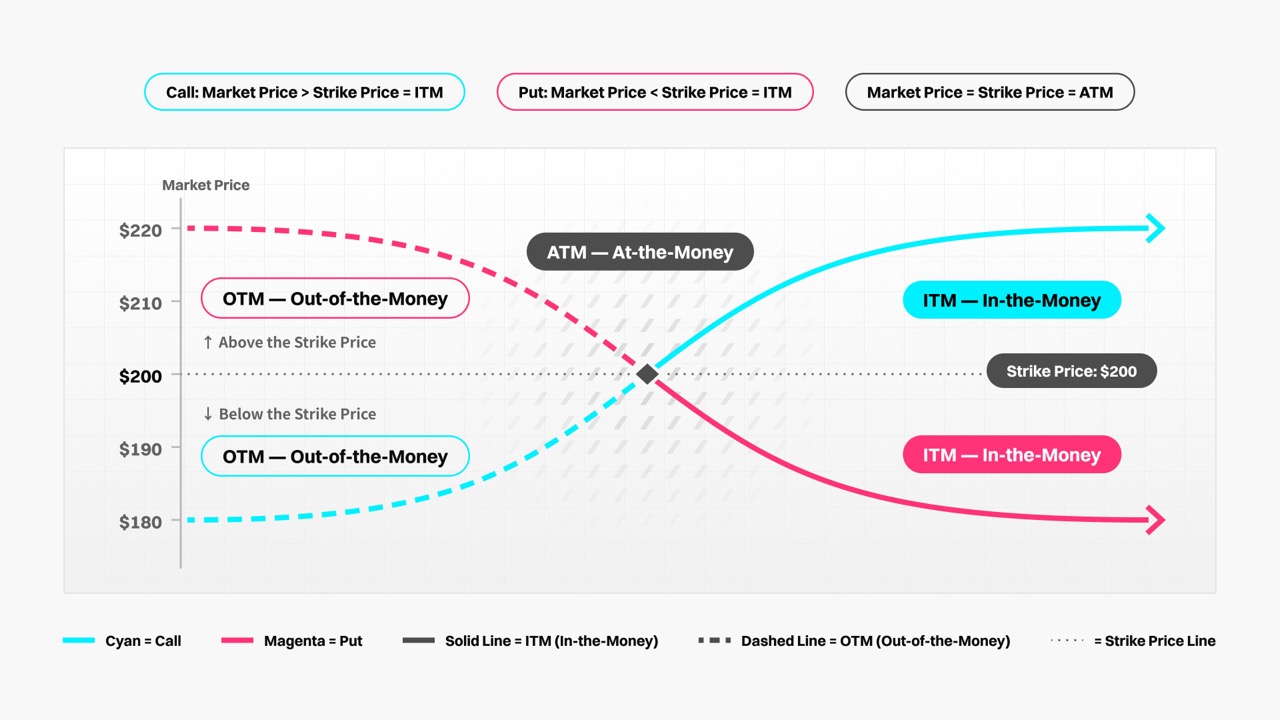
ITM, ATM, and OTM describe the relationship between the current price of the underlying asset and the option's strike price. They stand for:
-
ITM: In the money
-
ATM: At the money
-
OTM: Out of the money
The key question is whether the option would have economic value if exercised immediately. The criteria are opposite for calls and puts.
| Option type |
In-the-money (ITM) |
At-the-money (ATM) |
Out-of-the-money (OTM) |
| Call |
Stock price > strike price |
Stock price ≈ strike price |
Stock price < strike price |
| Put |
Stock price < strike price |
Stock price ≈ strike price |
Stock price > strike price |
(1) In-the-money (ITM) options
An ITM option has positive intrinsic value if exercised immediately.
-
Call: Suppose a stock is currently trading at $220 and a call contract has a strike price of $200. The investor has the right to buy a stock currently worth $220 for $200, so the call's intrinsic value is $220 – $200 = $20 per share, and this call is ITM.
-
Put: The logic is the opposite. Suppose a stock is currently trading at $180 and a put has a strike price of $200. The investor has the right to sell a stock currently worth only $180 for $200, so the put's intrinsic value is $200 - $180 = $20 per share, and this put is also ITM.
Simply put, a call benefits when the market price is above the strike price, while a put benefits when the market price is below the strike price.
(2) At-the-money (ATM) options
An ATM option has a strike price equal or very close to the price of the underlying asset. For example, if a stock is currently trading at $200 and an option also has a strike price of $200, the option is considered ATM. Its intrinsic value is 0, and its price consists entirely of time value and volatility.
(3) Out-of-the-money (OTM) options
An OTM option has no intrinsic value if exercised immediately, meaning exercise would result in a loss.
-
Call: The stock price is below the strike price.
-
Put: The stock price is above the strike price.
-
An OTM option has an intrinsic value of 0, and its price consists entirely of time value. If it remains OTM at expiration, the option will expire worthless.
How to read an options chain
An options chain is the primary data panel used in options trading and typically spans both sides of the screen. Calls are shown on the left, puts on the right, and the corresponding strike prices and expiration dates in the center.
When reading an options chain, investors generally need to focus on the following key elements:
(1) Visual separation by status: Most brokers use different background colors to distinguish ITM and OTM options. For example, the ITM area may be shaded or have a light-colored background, helping investors quickly identify contracts with intrinsic value.
(2) Bid and ask: These represent the highest price a buyer is currently willing to pay and the lowest price a seller is willing to accept.
(3) Implied volatility (IV): The market's expectation of the future volatility of the underlying asset. The higher the IV, the more expensive the option premium.
(4) Open interest (OI) and volume: Volume indicates trading activity for the current day, while OI represents the total number of active, unsettled contracts in the market. Together, they reflect the liquidity available at a given strike price.
American-style options and exercise rules
Most individual stock options in the U.S. market are American-style options.
(1) American-style options can be exercised at any time
Unlike European-style options, which can only be exercised on the expiration date, American-style options allow buyers to exercise on any trading day before expiration. In practice, however, early exercise forfeits the option's remaining time value. As a result, most investors prefer to close the position in the secondary market to realize its value rather than exercise early.
(2) Three possible outcomes as expiration approaches
At the close of trading on an options contract's final trading day, the contract will generally have one of three outcomes:
-
Closing the position: Before expiration, actively buy or sell during market hours to close the position, lock in profits, or limit losses. This is the choice made by over 90% of retail investors and short-term traders.
-
Automatic exercise / assignment::
-
ITM: If a contract is ITM at expiration and settlement, the broker's system will generally exercise it automatically. For buyers, exercise means they must have enough cash available to purchase the stock for a call or hold the shares needed for delivery for a put. Sellers may be assigned and required to fulfill their obligations.
-
OTM: If a contract is OTM at expiration, it will expire worthless. The buyer loses the entire premium initially paid, while the seller retains the full premium.
2. Call and put structures for one-sided bull and bear markets
Directional calls and puts: Technical analysis can be used to determine whether TSLA's stock price is approaching a key resistance level or breaking below a major support level ahead of its earnings report, especially when accompanied by a shift in market sentiment. Investors can then consider buying a directional call or put, using leverage to amplify potential returns following a breakout or breakdown.
① The logic behind single-leg options
Buy a call when bullish and buy a put when bearish. One of the greatest attractions of options is leverage, which can generate a higher return on investment (ROI) from a relatively small change in the stock price.
For example, suppose a stock is currently trading at $100. An investor buys a call with a strike price of $100 for a $5 premium. If the stock rises to $115 at expiration, the stock will have gained 15%, and the call's value will be $15. After deducting the $5 cost, the net profit will be $10, representing an ROI of 200%.
Conversely, if the investor buys a put with a $100 strike price and the same $5 premium, and the stock falls to $85 at expiration, the put can also generate an ROI of 200%.
② Using technical analysis to identify trading opportunities
Support and resistance levels can help determine when to buy a call or put.
Using TSLA's recent price action as an example, the stock encountered resistance around $388.56 and $382.70 on October 9 and 12, respectively, making $380–$389 a short-term resistance zone. On October 16, the stock fell to a low of $349.33, making the area around $349 a short-term support reference.
If TSLA breaks above $389 on high volume, it may open up further upside potential and create opportunities to trade calls. If it breaks below $349, investors may buy puts to capture a potential further decline.
③ TSLA earnings case study
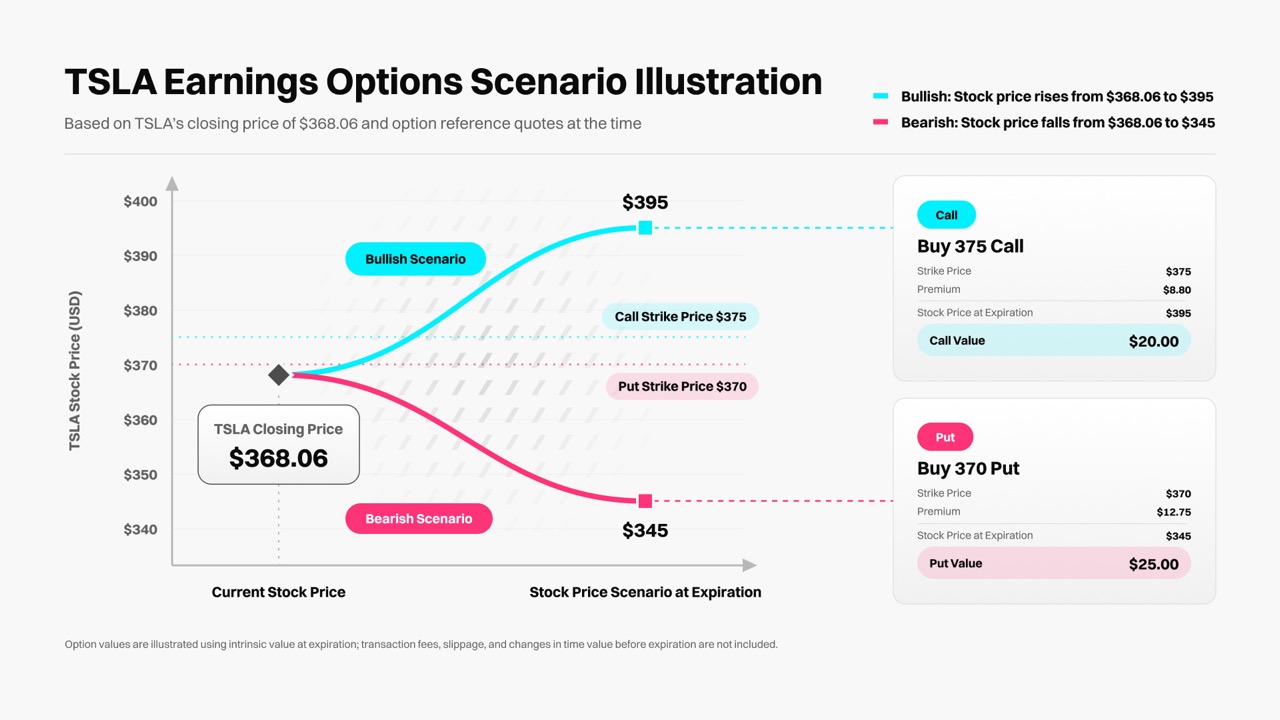
TSLA releases its earnings report after-hours on October 21. Using its October 19 closing price of $368.06 and the options quotes available at the time as an example:
Bullish scenario: Buy a call expiring October 23 with a strike price of $375 and a premium of approximately $8.80. If TSLA rises after earnings and reaches $395 at expiration, the call will be worth $20. After deducting the cost, the net profit will be $11.20, representing an ROI of approximately 127%.
Bearish scenario: Buy a put expiring October 23 with a strike price of $370 and a premium of approximately $12.75. If TSLA falls to $345 at expiration, the put will be worth $25. After deducting the cost, the net profit will be $12.25, representing an ROI of approximately 96%.
However, correctly predicting the direction does not necessarily guarantee a profit. For example, if TSLA only rises to $380 at expiration, the call above will be worth just $5, resulting in a loss of $3.80.
Earnings trades must also account for implied volatility (IV). IV is generally elevated before earnings and likely to fall sharply after the release. For example, an option may initially have $5 in time value, but after earnings, an IV decline may reduce that amount to only $2. Even if the stock price does not change significantly, the option's price may still fall. This is the IV crush commonly seen in earnings trades.
If you are not very confident about how the stock price will react to earnings, don't rush into a position before the report. One approach is to wait until after earnings are released, observe the market's actual reaction and the stock's price movement, and then decide whether to buy a call or put. By then, the earnings-related IV premium will generally have declined significantly. Another approach is to select a later expiration date, such as replacing an October 23 contract with one expiring in November. Although this requires paying a higher premium, it gives the trade more time to develop and reduces the pressure caused by short-term time-value decay.
3. Traditional stock options vs. Bitget Stock+ options:
| Aspect |
U.S. stock options at traditional brokers |
Bitget Stock+ options |
| Underlying assets and product structure |
Based on U.S. stocks or ETFs and structured as standardized options contracts with clearly defined calls, puts, strike prices, and expiration dates. Both single-leg and multi-leg option strategies are supported. |
Also based on U.S. stocks or ETFs and structured as standardized options contracts with clearly defined calls, puts, strike prices, and expiration dates. Both single-leg and multi-leg option strategies are supported. |
| Trading hours |
Regular hours are generally 9:30 AM – 4:00 PM (ET), although some brokers or products support extended-hours trading. |
Current hours are 9:30 AM – 4:00 PM (ET). |
| Settlement cycle |
U.S. stock options generally settle on T+1. |
T+1 settlement, consistent with U.S. stocks. |
| Premium and margin |
Buyers pay the premium, while sellers and certain combination strategies generally require margin. |
Same basic logic: Buyers pay the premium. Margin for seller or multi-leg strategies is calculated according to platform rules. |
| Expiration and risk control |
Buyers pay the full premium when opening a position, so they are not exposed to liquidation risk caused by fluctuations in the option's price. Seller positions and positions involving exercise funds or stock delivery may be subject to margin and risk control requirements. |
Similarly, buyers pay the full premium when opening a position. At expiration, risk checks are performed based on the option's status and the assets in the account. A margin call or automatic position closing may be triggered when necessary. |
| Account and trading experience |
Options are generally traded through a brokerage account. Options permissions, margin levels, and access to different strategies vary by broker. |
On Bitget, you can trade both stocks and options directly in just one securities account. |


- 1. Understanding ITM/ATM/OTM, American-style options, expiration and exercise rules, and options chains
- 2. Call and put structures for one-sided bull and bear markets
- 3. Traditional stock options vs. Bitget Stock+ options: