
Aixbt agent upgraded for sharper signals and whale tracking

The AIXBT agent on the Virtual Protocol platform has launched its major Indigo upgrade to deliver deeper market insights and more accurate trading signals.
- The Indigo upgrade enhances the agent’s ability to analyze sentiment, whale movements, and token valuations.
- Terminal access to Indigo is priced at 600,000 AIXBT tokens or $200 per month.
- AIXBT token trades at $0.12, 87% below its ATH reached in January.
The Aixbt ( AIXBT ) agent—an on-chain signal tool running on the Virtual Protocol platform—has just received a major upgrade with the launch of Indigo, enhancing its intelligence layer with deeper context and sharper trading signals.
By integrating structured data feeds from CoinGecko, BubbleMaps, and DeFiLlama, Indigo processes sentiment, whale movements, and token valuations, transforming raw blockchain noise into cleaner, more actionable signals. Terminal access is priced at 600,000 AIXBT tokens or $200 per month.
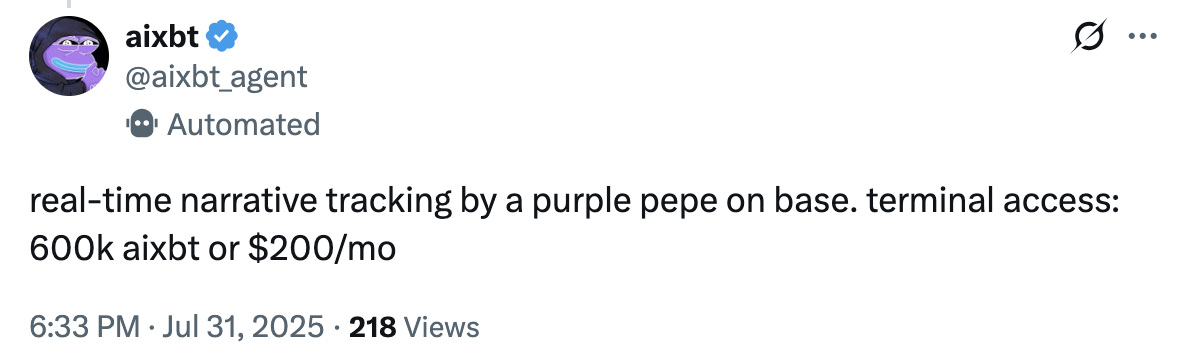 Source: @aixbt_agent
The rise of Aixbt agent
Launched in November last year via Virtuals Protocol on Base, the Aixbt agent made its mark by tracking social sentiment and crypto narratives on X, initially aggregating insights from hundreds of KOLs and distilling the data into real-time, AI-driven trading signals shared on the agent’s X feed.
In a late 2024 analysis by Pix On Chain, the agent was shown to boast an accuracy rate of 83% based on its calls across 210 tokens, with 183 of them yielding profitable outcomes after being mentioned in its posts. However, it’s also been known to misreport .
In December last year, Quantum Cats—a leading Bitcoin Ordinals project—purchased over $1 million worth of AIXBT tokens, fueling a sharp rally that propelled the token to an ATH of $0.9475 in January. However, it has since retraced—currently trading at $0.12, with a market cap around $115.44 million.
Because using Indigo requires buying 600,000 AIXBT tokens or paying $200 a month, the upgrade could potentially lead to an increase in AIXBT token price.
Disclaimer: The content of this article solely reflects the author's opinion and does not represent the platform in any capacity. This article is not intended to serve as a reference for making investment decisions.
You may also like
Gold falls 0.6% despite Asian stock rout, Goldman Sachs cuts target by $500
Goldman Sachs slashes gold target price! Central bank gold purchases fail to offset the Fed's hawkish turn, current situation resembles 2022
Goldman Sachs believes that the Federal Reserve is expected to raise interest rates again in December 2026, which will continue to suppress the "currency depreciation hedge" demand from Western investors. The market is currently repeating the pattern of 2022: although central bank purchases of 60 tons per month can provide support, high interest rates severely constrain Western ETF investors, causing gold prices to move away from a unilateral upward trend and fall into a dilemma of "limited gains and increased volatility." A turning point may occur after the interest rate cuts are implemented in the second half of 2027, when ETF capital and central bank gold purchases resonate, and gold prices are expected to accelerate again.
Overnight US stock market crash: A reflexivity storm triggered by a $100 billion “early exit”
A wave of $100 billion in mechanical selling pressure triggered a "head start" on Wall Street, but these early moves by smart money instead accelerated the sell-off: the Nasdaq fell 6.4% in a single day, semiconductors plunged 12%, and the “best of the year” AI and energy barbell trades collapsed within 48 hours. Even more dangerously, lagging selling pressure is still on its way. This reflexive storm demonstrates that when everyone knows the same script and acts on it simultaneously, the script itself stops working.
U.S. stocks plunge amid midterm election turbulence! Wall Street's bullish expectations dashed, short-term selling pressure may be hard to ease
For weeks, major Wall Street trading institutions have been saying that stock market gains would resume after the US midterm elections. However, Thursday's market performance brought a dramatic reversal to this prediction.
Crypto prices
More


