
Wisconsin bill to exempt crypto businesses from money licenses

Wisconsin lawmakers have introduced a bill on Monday that, if enacted, would exempt individuals and businesses in the state from requiring money transmitter licenses to participate in mining, staking and exchanging digital assets.
According to a document from the Wisconsin Legislative Reference Bureau, the bill seeks to clearly define exemptions from requiring a license from the Department of Financial Institutions for money transmission-related activities.
Under the proposed exemptions of Wisconsin Assembly Bill 471, individuals or businesses would not need DFI licences for crypto mining, staking and developing blockchain software.
It also exempts the exchanging of digital assets if the transactions don’t involve the “conversion to legal tender” or bank deposits.
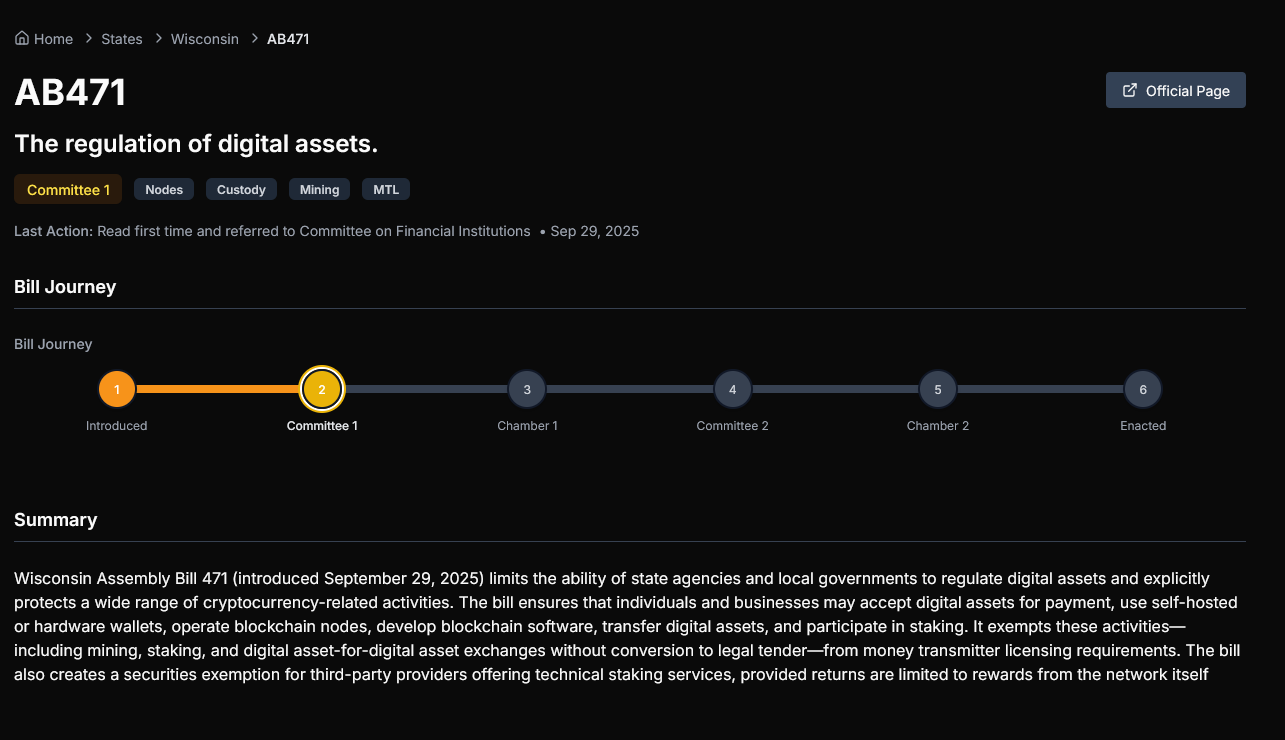
“Under the bill, neither a state agency nor a political subdivision may prohibit or restrict a person in accepting digital assets as a method of payment for legal goods and services or in taking custody of digital assets using a self-hosted wallet or hardware wallet,” the document reads, adding that:
“The bill also specifies that a person in this state may 1) operate a node for the purpose of connecting to a blockchain protocol and participating in the blockchain protocol’s operations; 2) develop software on a blockchain protocol; 3) transfer digital assets to another person utilizing a blockchain protocol; and 4) participate in staking on a blockchain protocol.”
The bill marks another attempt to reduce some of the legal gray area surrounding state-based crypto regulation. There is still a lack of clear rules across the country for crypto despite increasing adoption.
Wisconsin bill still has hurdles to pass
The bill is sponsored by seven Republican members at the House level, and two Republican co-sponsors from the Senate, and has since been referred to the Committee on Financial Institutions.
According to Legiscan, the bill has a current progression rate of 25%, as it still has to pass through one chamber and two more committees before it could potentially be enacted.
Disclaimer: The content of this article solely reflects the author's opinion and does not represent the platform in any capacity. This article is not intended to serve as a reference for making investment decisions.
You may also like
Overnight US Stocks | The three major indexes were mixed; most chip stocks rebounded; Micron Technology (MU.US) rose over 5%
At the close, the Dow Jones fell by 237.32 points, down 0.46%, to 51,285.73 points; the S&P 500 rose by 23.13 points, up 0.31%, to 7,376.86 points; the Nasdaq gained 264.42 points, up 1.09%, to 24,579.42 points.
Bank of Japan Governor: Inflation Risks Are on the Upside; Unconventional Easing Tools May Be Used Again if Severe Shocks Occur in the Future
Bank of Japan Governor Kazuo Ueda stated that core inflation is expected to remain near the 2% target, with wage growth gradually aligning with inflation. However, rising energy prices have begun to impact consumer prices, and inflation may accelerate further early next year. He also noted that AI has created a positive demand shock, and with a labor shortage in Japan, AI replacing some jobs could benefit the Japanese economy.

Solana DEX volume hits $60 billion, RWA value reaches $5 billion in October 2026

Crypto liquidations hit $1 billion as Bitcoin briefly slips below $75,000

Crypto prices
More


