In 2022, hopes that Bitcoin could serve as a reliable hedge against inflation evaporated. As inflation climbed, Bitcoin faltered, causing skeptics to question its credentials as a financial safe haven. Meanwhile, cracks appeared in the once-heralded correlation between Bitcoin and gold, further undermining the digital gold narrative. Now, prominent crypto commentators Ran Neuner and Willy Woo are turning a critical eye to developments that raise serious questions for Bitcoin’s future as a protective asset.
Willy Woo’s Quantum Warning
Renowned for his market cycle predictions, cryptocurrency analyst Willy Woo commands attention among digital asset investors. Woo recently compared Bitcoin to gold, cautioning, “If you don’t want to lose hope, you might not want to listen to me.” He pointed to a major break in the twelve-year trend supporting Bitcoin’s strength, noting that quantum computing risks have disrupted established patterns—and that further upheaval may follow.

“Most likely, BTC will be patched with quantum-resistant signatures. But that won’t solve the issue of 4 million lost coins potentially re-entering circulation. I’d estimate there’s a 75% chance the protocol hard fork won’t freeze these lost coins.
This means that risk-adjusted trading should price in the possibility of these 4 million coins returning. To put it in perspective, since Strategy began accumulating BTC in 2020, all companies and spot ETFs have together acquired only 2.8 million BTC.
Those 4 million lost BTC equal eight years of institutional accumulation.
The market has already begun pricing in the return of these coins. That process will end once Q-Day risk is truly removed. Until then, BTCUSD will reflect this uncertainty.
Q-Day is estimated to be five to fifteen years away. So, for a considerable time, the market faces this cloud of uncertainty. Ironically, the next decade is when BTC will be needed most—at the end of a long-term debt cycle, when macro investors and governments seek shelter from global debt reduction by turning to hard assets like gold,” Woo explained.
Reevaluating Bitcoin’s Role
Ran Neuner echoes much of Woo’s skepticism, admitting that for the first time in twelve years he finds himself questioning Bitcoin’s intended purpose. Neuner is less concerned with price decline than with how Bitcoin behaves when markets encounter real risk and uncertainty. Launched as a “peer-to-peer cash” system—a decentralized vehicle for everyday payments—Bitcoin later pivoted to become a supposed haven, likened to digital gold.
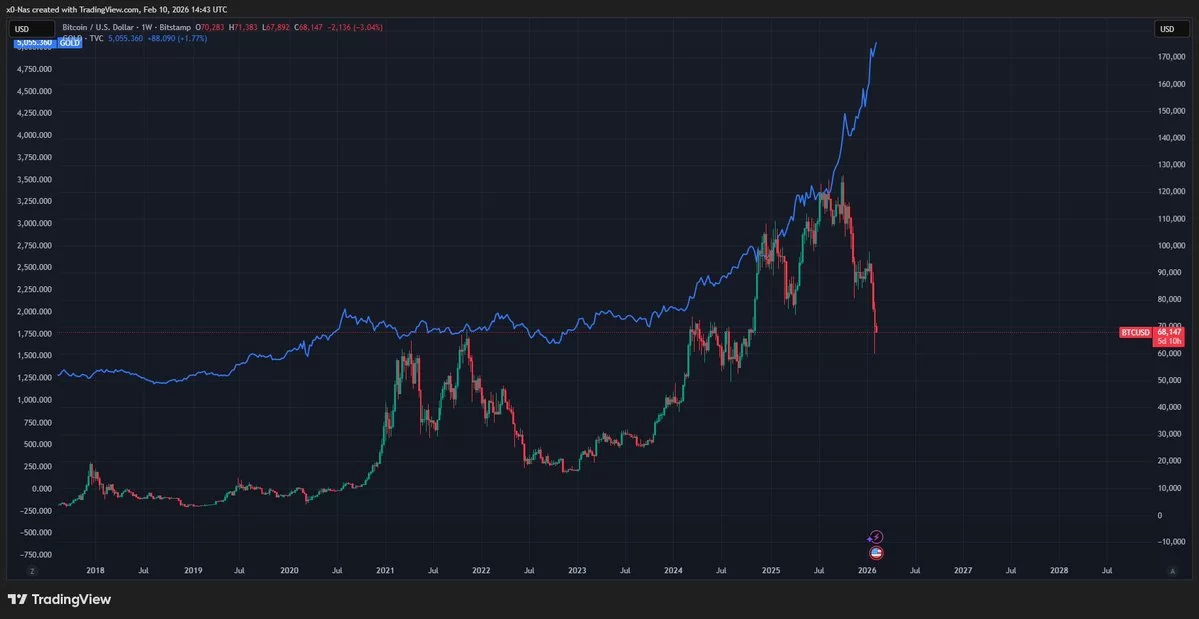
What was once a thrilling prospect—the integration of Bitcoin into the traditional financial system—has now become the very development sapping much of the optimism from the space.
- We fought for ETF approval.
- We pushed for institutional access.
- We welcomed Bitcoin into the core financial establishment.
“There’s nothing left to fight for. When customs tariffs, currency tensions, and fiscal instability surfaced, it was time for Bitcoin to fulfill its promise as a store of value. Instead, capital flowed into gold. Institutions enjoyed unrestricted access. No barriers remained.
This is the unsettling reality. If Bitcoin isn’t used as cash and fails to absorb stress meaningfully, then what is its true story? Individual investor participation has plunged to multi-year lows. The early evangelists have largely exited the market.” Neuner continued,
“This doesn’t mean Bitcoin is dead. But it does give me pause. Curiously, my concern is not about cryptocurrencies in general but about Bitcoin itself. The next wave won’t arrive for ideological reasons. AI agents won’t bank. They won’t use credit cards. They’ll require instant, programmable payment channels—which means cryptocurrency.”
Woo and Neuner’s analyses underscore an inflection point in Bitcoin’s history. Both see major challenges ahead—from technical hurdles posed by quantum computing to existential doubts about Bitcoin’s capacity to function as a resilient store of value when crisis strikes.
For years, credence in the digital gold theory gave Bitcoin an aura of inevitability. But the disappointment of its inflationary performance and its inability to absorb macroeconomic shocks have rattled even ardent supporters. The market now faces growing uncertainty about whether Bitcoin still merits its status as an uncorrelated safe haven.
As the next technological and financial era emerges, questions abound about Bitcoin’s role in a landscape where programmable money and AI-driven interactions may dominate. While core blockchain principles endure, the crypto movement itself is evolving—and with it, the myths and realities surrounding Bitcoin’s place within global finance.