
Energym AI dystopia goes viral as crypto projects tout user-owned AI agents

A viral spoof “Energym” advertisement set in a 2030s world where 80% of people have lost their jobs to artificial intelligence has struck a nerve as companies accelerate automation, job openings slump and investors grapple with darker AI scenarios.
The video , created by Belgian studio AiCandy, uses AI-aged versions of Elon Musk, Sam Altman and Jeff Bezos to hawk a fictional gym where unemployed workers pedal bikes and row machines to power the very AI systems that replaced them, trading lost income for a new sense of “purpose.”
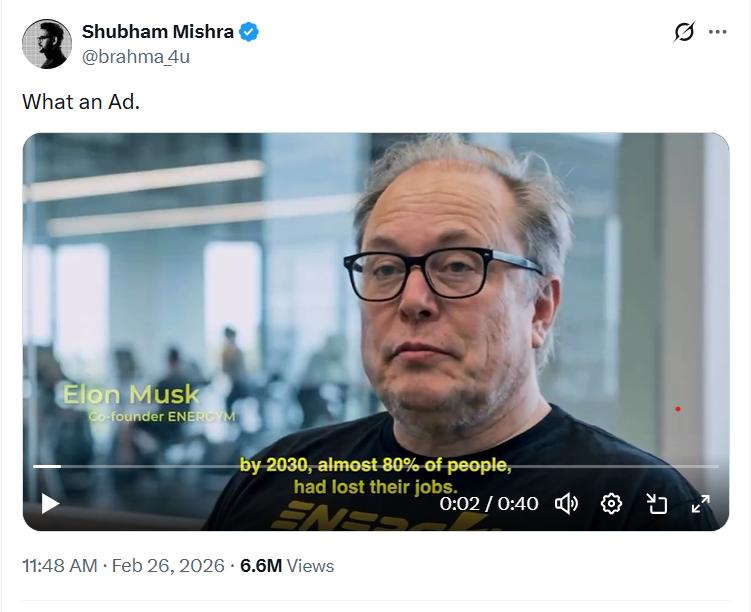 The Energym scenario. Source:
Energym’s dystopia meets real AI layoffs
The satire lands amid a real wave of tech restructuring built around AI tools rather than human staff.
On Friday, Jack Dorsey’s fintech firm Block announced that it was cutting more than 4,000 roles (close to 40% of its workforce), in a bid to go lean using intelligence tools, paired with “smaller and flatter teams.”
Related: Bitcoin to see tailwinds if AI prompts ‘easier monetary policy’: NYDIG
Fresh labor market data from the US Bureau of Labor Statistics show demand for some office jobs has cooled. Finance and insurance openings fell to 134 a month by December 2025, 50% lower than the year prior, marking a decade-long low.
 Finance and insurance job openings. Source:
Market jitters over where this trajectory leads intensified in February when a 7,000‑word scenario from Citrini Research, a US firm that provides insights on “transformative” trends, sketched out a future of AI agents, cascading layoffs, falling wages, and a deep market crash later this decade.
The report, framed as a scenario rather than a forecast, nevertheless helped drive a sell-off in software and payments stocks, with companies such as Uber, American Express, and Mastercard dropping between 4% and 6% in one session as investors reassessed how quickly AI could erode demand for human labor.
Crypto-native agents as an alternative to “Energym?”
For David Minarsch, CEO of Valory and founding member of Olas Network, a crypto protocol for co-owned AI agents, the Energym vision is one possible path if AI remains “built as black boxes” and owned by a handful of centralized platforms.
He told Cointelegraph that rapid AI deployment was already reshaping software engineering, with almost all his team’s code now generated by AI under human oversight compared to mostly human-written code just six months ago.
Related: AI ‘vibe coding’ could put Ethereum roadmap ahead of schedule: Vitalik Buterin
“If this trend accelerates,” he said, we are on a path to a future that’s caricatured in the Energym ad,” arguing that society was at a “pivotal inflection point.”
Minarsch warned that a world where AI agents are granted something like personhood and legal protections could permanently “disenfranchise humans” by turning capital, rather than labor, into the dominant input for production.
He pointed to AI labs that describe models as being “retired” as an early step toward treating systems as stakeholders in their own right.
Minarsch said that projects like Olas were betting that giving people direct ownership and control over AI agents, rather than renting them from platforms, could be one way to stop the Energym scenario from becoming a reality.
Magazine: How crypto laws changed in 2025 — and how they’ll change in 2026
Disclaimer: The content of this article solely reflects the author's opinion and does not represent the platform in any capacity. This article is not intended to serve as a reference for making investment decisions.
You may also like
JPMorgan Brings JPM Coin to Ethereum for Institutions

How Ethereum Could Stay Secure Even If Today’s Online Locks Stop Working

Cardano Price Prediction: Can ADA Defend $0.22 as Hoskinson Builds a New Programming Language?
 VIPAI Asset Sell-Off and Selective Rotation in Crypto
1. Technology stocks fell sharply as investor interest shifted toward energy and selected defensive assets. From October 10 to 16, the Nasdaq 100 declined 5.49% and the S&P 500 fell 1.95%, while the Dow gained 0.67% and WTI crude rose 10.41%. BTC, ETH, and SOL declined 1.27%, 2.65%, and 4.44%, respectively. This week's technology earnings will be an important test of whether revenue growth, margins, and cash flow can justify current valuations. Better-than-expected results could help stabilize markets in the near term. 2. Crypto continues to see pockets of strong activity, but a broad-based altcoin season has yet to materialize. CoinMarketCap's (CMC) Altcoin Season Index stood at 54 as of the October 18 UTC daily observation, below the altcoin-season threshold of 75, while BTC dominance rose to 60.08%. Our proxy leverage ratio fluctuated between 4.00 and 4.07 during the week, showing no sustained increase and suggesting limited appetite for additional leverage. Meanwhile, as major exchanges expand access to traditional financial assets, the recent sell-off in AI-related equities could attract short-term speculative capital away from crypto. Such capital rotation could make it more difficult for a new altcoin season to take hold. 3. Papertrade's loss-to-mine model has generated significant interest across the crypto community. The protocol combines high-leverage derivatives trading with zero slippage and a mechanism that rewards trading losses with PAPER tokens. Across the eight complete UTC days from October 10 to 17, cumulative reported revenue reached approximately $56.08 million, including $51.90 million distributed to token holders. With growing participation from key opinion leaders (KOLs), Papertrade has reportedly ranked among the top three platforms by profitability in the broader market recently. Assets to watch: BTC, ETH, SOL, ARB, OP, SKHYNIX, SKHY, META, TSLA, LRCX, and SPCX. Key research priorities this week: Cash flow performance in technology earnings; the relative discount and holding costs of the two SK Hynix contracts; and U.S. initial jobless claims and PMI data. Weekly market data cover the period through October 16, while research information was verified through October 18. Observation periods are specified separately for each chart.

Crypto prices
More


