
EU’s regulated blockchain securities market adds first bank participant

Amina, a Swiss-regulated crypto bank, has joined a blockchain-based settlement platform for tokenized securities operating under the European Union’s DLT pilot regime, marking another step toward integrating digital asset infrastructure with traditional capital markets.
The Zug, Switzerland-based company announced Monday that it has become a listing sponsor on the EU-regulated platform 21X, making Amina the venue’s first fully regulated bank participant.
Amina said the move will allow it to support companies issuing tokenized securities on 21X through its partnership with Tokeny, a Luxembourg-based company that provides technology for creating and managing tokenized financial assets.
The collaboration aims to address a key barrier to institutional adoption of tokenized assets by connecting regulated banks with the issuance and trading of tokenized securities.
21X received an infrastructure permit under the EU’s DLT pilot regime in December 2024, allowing it to run a regulated market for blockchain-based securities in a regulatory test environment.
“A lack of interoperability of tokenized asset platforms” was cited by Baker McKenzie’s European Financial Services practice in June as one of the main obstacles to the adoption of tokenization among financial institutions. “Scale will only be achieved when numerous market players are transacting with each other on common or interconnected platforms,” Zurich partner Yves Mauchle wrote on the firm’s blog.
Introduced in 2023, the DLT framework allows market operators to experiment with blockchain-based trading and settlement of financial instruments within a regulatory sandbox. The program is intended to help regulators evaluate how the technology could fit into existing market infrastructure.
Despite early uptake, the regime has faced scrutiny from industry participants, who warn that its current limits could prevent European onchain markets from scaling and competing with other jurisdictions. It remains unclear whether participation from regulated banks such as Amina will help accelerate adoption.
Related: Crypto exchanges gain as tokenized commodity market climbs to $7.7B
Strong growth of tokenized real-world assets
The development comes as financial institutions increasingly invest in blockchain infrastructure for tokenized assets. In the United States, institutions including BNY, Nasdaq and S&P Global recently backed the expansion of the Canton Network, while Europe is testing regulated blockchain trading venues such as 21X under the EU’s DLT pilot regime.
In February, eight EU-regulated digital asset companies urged policymakers to accelerate digital asset legislation, warning that the bloc risks falling behind the United States and other jurisdictions in developing tokenized financial markets.
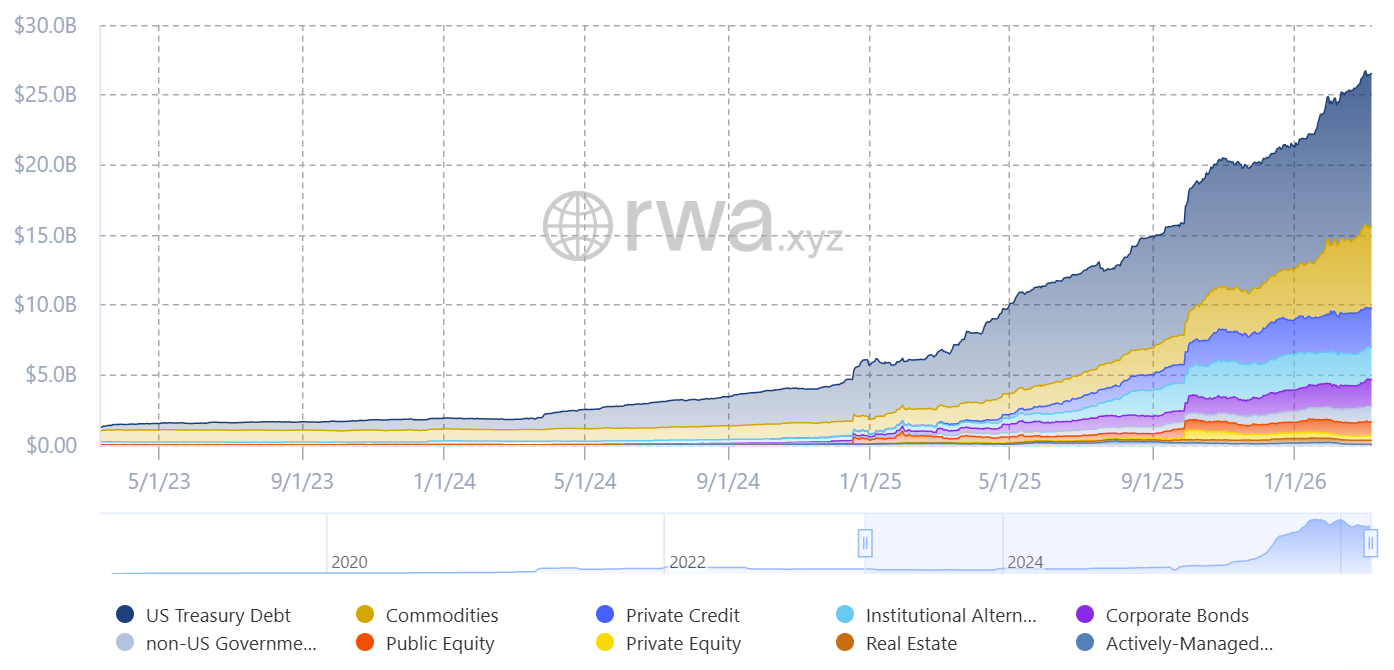
To be sure, positive developments are taking place. In September, crypto exchange Kraken launched tokenized securities trading for European users through its xStocks platform, which offers blockchain-based versions of US-listed equities.
Two months later, tokenization platform Ondo received regulatory approval in Liechtenstein to offer tokenized equities trading to European investors.
Related: Crypto Biz: Kraken plugs into the Fed
Disclaimer: The content of this article solely reflects the author's opinion and does not represent the platform in any capacity. This article is not intended to serve as a reference for making investment decisions.
You may also like
How Ethereum Could Stay Secure Even If Today’s Online Locks Stop Working

Cardano Price Prediction: Can ADA Defend $0.22 as Hoskinson Builds a New Programming Language?
 VIPAI Asset Sell-Off and Selective Rotation in Crypto
1. Technology stocks fell sharply as investor interest shifted toward energy and selected defensive assets. From October 10 to 16, the Nasdaq 100 declined 5.49% and the S&P 500 fell 1.95%, while the Dow gained 0.67% and WTI crude rose 10.41%. BTC, ETH, and SOL declined 1.27%, 2.65%, and 4.44%, respectively. This week's technology earnings will be an important test of whether revenue growth, margins, and cash flow can justify current valuations. Better-than-expected results could help stabilize markets in the near term. 2. Crypto continues to see pockets of strong activity, but a broad-based altcoin season has yet to materialize. CoinMarketCap's (CMC) Altcoin Season Index stood at 54 as of the October 18 UTC daily observation, below the altcoin-season threshold of 75, while BTC dominance rose to 60.08%. Our proxy leverage ratio fluctuated between 4.00 and 4.07 during the week, showing no sustained increase and suggesting limited appetite for additional leverage. Meanwhile, as major exchanges expand access to traditional financial assets, the recent sell-off in AI-related equities could attract short-term speculative capital away from crypto. Such capital rotation could make it more difficult for a new altcoin season to take hold. 3. Papertrade's loss-to-mine model has generated significant interest across the crypto community. The protocol combines high-leverage derivatives trading with zero slippage and a mechanism that rewards trading losses with PAPER tokens. Across the eight complete UTC days from October 10 to 17, cumulative reported revenue reached approximately $56.08 million, including $51.90 million distributed to token holders. With growing participation from key opinion leaders (KOLs), Papertrade has reportedly ranked among the top three platforms by profitability in the broader market recently. Assets to watch: BTC, ETH, SOL, ARB, OP, SKHYNIX, SKHY, META, TSLA, LRCX, and SPCX. Key research priorities this week: Cash flow performance in technology earnings; the relative discount and holding costs of the two SK Hynix contracts; and U.S. initial jobless claims and PMI data. Weekly market data cover the period through October 16, while research information was verified through October 18. Observation periods are specified separately for each chart.

Why Bernstein Thinks the AI Stock Sell-Off Could Help Small Caps

Crypto prices
More


