
BitGo expands Canton Coin services with trading, onchain settlement

Digital asset infrastructure provider BitGo has expanded support for Canton Coin, adding trading and settlement services to its existing custody offering, in a move that aligns with a wider industry push to develop trading and settlement rails for tokenized financial assets.
In a Monday announcement, BitGo said it has become one of the first US-based regulated providers to offer custody, over-the-counter (OTC) trading and settlement for Canton Coin within a single platform, although similar bundled services have begun emerging across the digital asset sector.
BitGo initially began supporting the asset in October, allowing institutions to hold Canton Coin with a qualified custodian.
The latest update enables clients to trade Canton Coin electronically or via BitGo’s OTC desk, mirroring how traditional assets are executed in institutional markets. It also introduces settlement through the network’s infrastructure, allowing counterparties to complete transactions onchain.
BitGo said the expansion is part of its broader push to support tokenized finance, an area gaining traction among banks and financial institutions exploring blockchain-based settlement and asset issuance, with parallel efforts underway at firms such as Fireblocks and JPMorgan, which have also been developing tokenized settlement and payment systems.
Canton Coin has grown since late 2025, with its market capitalization reaching nearly $6 billion, according to CoinMarketCap data. The increase comes amid broader interest in tokenization and permissioned blockchain networks designed for regulated use cases.
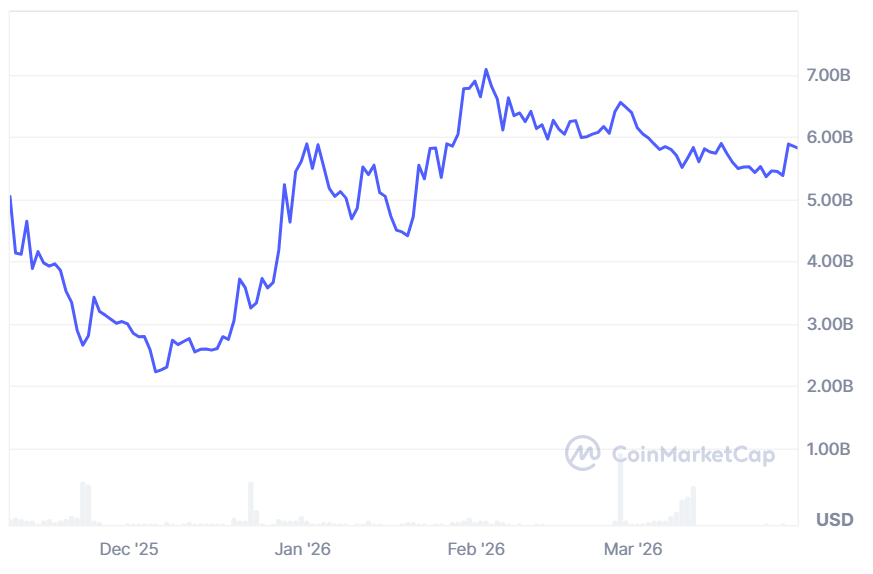 Canton Coin’s market cap has more than doubled since December. Source:
CoinMarketCap
Canton Coin is the utility token of the Canton Network, a layer-1 blockchain developed by Digital Asset. The network is designed for institutional adoption, with privacy and compliance features.
Related: Fireblocks integrates Canton Network for regulated onchain settlement
Institutional participation grows amid regulatory developments
The move comes amid growing institutional participation in the digital asset market, supported by major industry developments and a gradually evolving regulatory framework.
In a 70-page report released in December, Coinbase said institutional adoption was approaching an inflection point despite ongoing market volatility.
The crypto exchange pointed to evolving US legislation, including the GENIUS Act on stablecoins and potential progress on a broader crypto market structure bill, as factors that could accelerate institutional involvement.
 Institutional adoption mirrors broader trends in US policy developments. Source: Coinbase Institutional
A separate report published in January by Binance Research similarly found that institutional capital is playing an increasingly prominent role in digital asset markets, with activity shifting away from retail-driven trading.
Related: Crypto Biz: Stablecoin jitters meet institutional momentum
Disclaimer: The content of this article solely reflects the author's opinion and does not represent the platform in any capacity. This article is not intended to serve as a reference for making investment decisions.
You may also like
Tesla Cybertruck: From Cracked Windows to Production Halt, a Three-and-a-Half Year Journey Ends
Since its launch in 2019, Cybertruck has been mired in controversy—ranging from a failed window demonstration on release day, a four-year delay in mass production, and its price rising from $39,900 to more than $100,000, along with a total of 11 recalls. The day before the halt of production was announced, Tesla raised the price once again, bringing a dramatic and intriguing end to the saga of this vehicle.

AI capital expenditure “peaks”; is the US economy also “peaking”?


Democrats to destroy the data center boom? Goldman Sachs bucks the trend with an upgrade forecast!
Goldman Sachs has raised its forecast for US data center construction spending against the trend, increasing the 2026 projection from $67 billion to $80 billion and, for the first time, projecting $125 billion for 2028. Despite the market panic caused by Texas's moratorium, Goldman Sachs believes this is essentially a delay rather than a termination, and the overall construction cycle remains resilient. However, highly leveraged developers face substantial risks from rising financing costs and contract cancellations.

Crypto prices
More


