
Business use of stablecoins set for growth surge: Cybrid report

Business use of stablecoins is poised to surge in the next 12 months as adoption of the digital currency goes mainstream, according to a new report from payments infrastructure firm Cybrid.
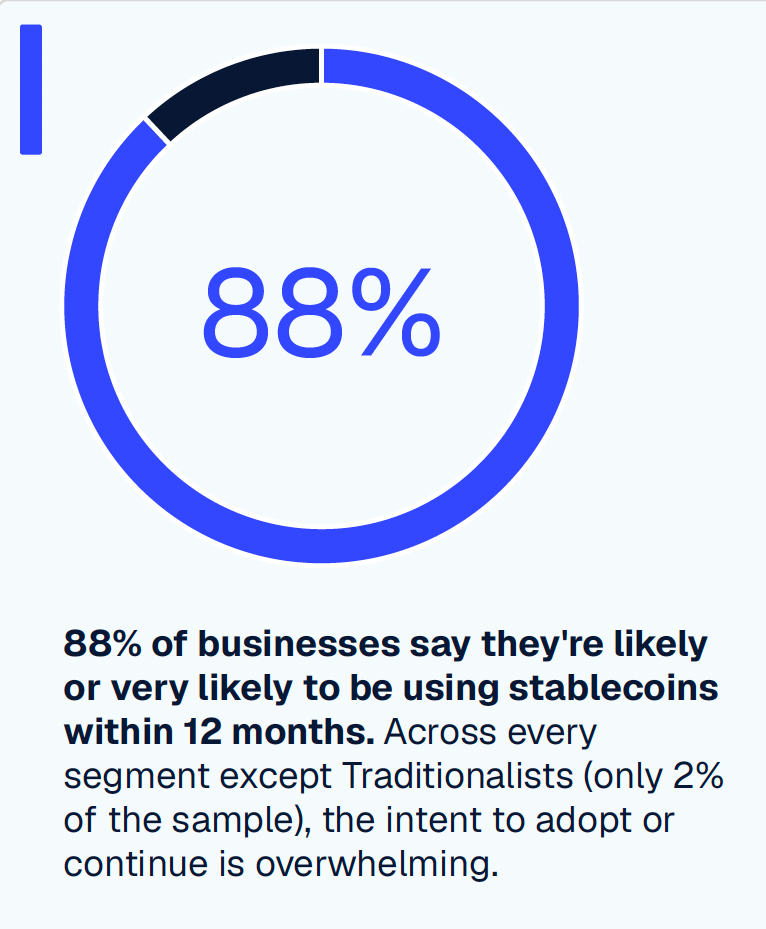
The report found 42% of businesses surveyed are already using stablecoins for cross-border payments and 88% of respondents said they are likely or very likely to use stablecoins within the next 12 months. Still, only 2% identified as committed users of traditional payment rails.
Businesses using stablecoins reported average cross-border payment cost savings of 35%, with companies processing more than $100 million in monthly payment volume reporting average savings of up to 47%, according to the survey.
Source: Cybrid report
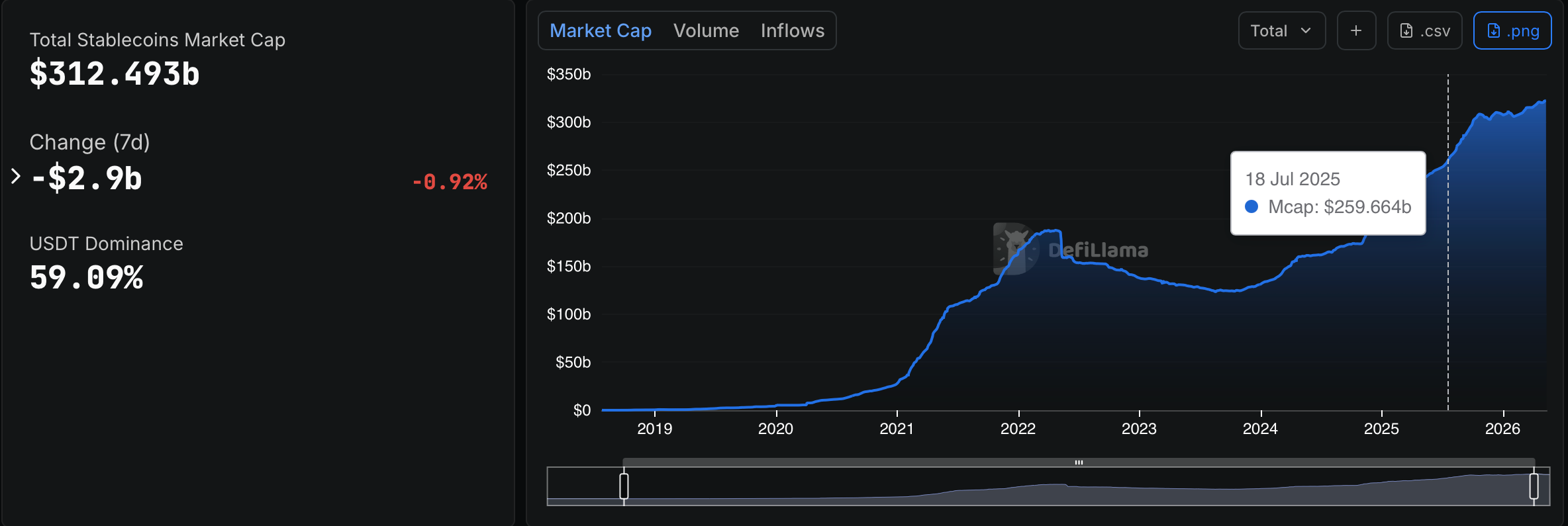
The global stablecoin market cap is now at $307.64 billion, led by Tether's USDT, at $184.7 billion, and Circle's USDC, at $73.51 billion, Coingecko data shows. Fueled by recent legislation, GENIUS Act-compliant stablecoins have reached a market cap of more than $76 billion. That established the first federal regulatory framework for payment stablecoins in the United States.
The report is based on a survey of 468 executives and business leaders conducted between April 28 and May 4.
Varied users look for regulatory clarity to gain confidence
Payroll and contractor payments were the most common stablecoin use case among respondents, followed by supplier payments, customer payments, investment and yield generation, vendor payments, and treasury and liquidity management.
Regulatory clarity was also a top factor respondents said would increase their confidence in expanding stablecoin use, with 71% identifying it as more important than trusted infrastructure providers or integration with existing systems.
Respondents came from the technology, financial services and ecommerce sectors in the United States, Canada and the United Kingdom, including C-suite executives, finance and treasury managers, and payments and operations leaders.
Companies expand infrastructure for stablecoin payments
Separate industry data points to the same trend. In June, payments infrastructure provider Paybis said business customers accounted for nearly 98% of stablecoin payout volume processed through its platform during the first four months of 2026, up from 36% in 2023.
Paybis also cited McKinsey research estimating that business-to-business transactions accounted for roughly 60% of the $390 billion in global stablecoin payment volume recorded in 2025.
Companies have continued expanding infrastructure to support growing business demand. In May, Falcon Finance debuted the dollar-backed stablecoin fUSD through Anchorage Digital Bank's federally regulated issuance platform, targeting institutional trading, collateral and treasury workflows.
On Monday, BNY expanded its digital asset custody platform to support Circle's USDC, allowing institutional clients to store, transfer, mint and redeem the stablecoin directly through the bank.
Disclaimer: The content of this article solely reflects the author's opinion and does not represent the platform in any capacity. This article is not intended to serve as a reference for making investment decisions.
You may also like
JPMorgan Brings JPM Coin to Ethereum for Institutions

How Ethereum Could Stay Secure Even If Today’s Online Locks Stop Working

Cardano Price Prediction: Can ADA Defend $0.22 as Hoskinson Builds a New Programming Language?
 VIPAI Asset Sell-Off and Selective Rotation in Crypto
1. Technology stocks fell sharply as investor interest shifted toward energy and selected defensive assets. From October 10 to 16, the Nasdaq 100 declined 5.49% and the S&P 500 fell 1.95%, while the Dow gained 0.67% and WTI crude rose 10.41%. BTC, ETH, and SOL declined 1.27%, 2.65%, and 4.44%, respectively. This week's technology earnings will be an important test of whether revenue growth, margins, and cash flow can justify current valuations. Better-than-expected results could help stabilize markets in the near term. 2. Crypto continues to see pockets of strong activity, but a broad-based altcoin season has yet to materialize. CoinMarketCap's (CMC) Altcoin Season Index stood at 54 as of the October 18 UTC daily observation, below the altcoin-season threshold of 75, while BTC dominance rose to 60.08%. Our proxy leverage ratio fluctuated between 4.00 and 4.07 during the week, showing no sustained increase and suggesting limited appetite for additional leverage. Meanwhile, as major exchanges expand access to traditional financial assets, the recent sell-off in AI-related equities could attract short-term speculative capital away from crypto. Such capital rotation could make it more difficult for a new altcoin season to take hold. 3. Papertrade's loss-to-mine model has generated significant interest across the crypto community. The protocol combines high-leverage derivatives trading with zero slippage and a mechanism that rewards trading losses with PAPER tokens. Across the eight complete UTC days from October 10 to 17, cumulative reported revenue reached approximately $56.08 million, including $51.90 million distributed to token holders. With growing participation from key opinion leaders (KOLs), Papertrade has reportedly ranked among the top three platforms by profitability in the broader market recently. Assets to watch: BTC, ETH, SOL, ARB, OP, SKHYNIX, SKHY, META, TSLA, LRCX, and SPCX. Key research priorities this week: Cash flow performance in technology earnings; the relative discount and holding costs of the two SK Hynix contracts; and U.S. initial jobless claims and PMI data. Weekly market data cover the period through October 16, while research information was verified through October 18. Observation periods are specified separately for each chart.

Crypto prices
More


