
Solana Foundation launches framework for protocol-level governance

The Solana Foundation, the Swiss organization that supports the Solana network’s development, launched a new framework for protocol-level governance that enables proposing and voting on governance decisions for the Solana blockchain.
The Solana Governance Proposals (SGPs) establish a standard that enables validators to submit core protocol proposals and vote onchain, with voting power based on their delegated Solana (SOL) stake, the Foundation announced in a Thursday X post.
“An SGP captures a stake-weighted directional decision. It records what the community wants. It is not strictly focused on the technical detail of how to build the feature,” according to the GitHub repository, launched on Thursday.
The new framework offers Solana a transparent, community-driven way to make major protocol decisions, reducing reliance on centralized coordination while keeping technical implementations, or Solana Improvement Documents (SIMDs), separate from community governance.
Other blockchain networks with similar stake-weighted governance mechanisms include Polkadot, Cosmos, Cardano, Tezos and Avalanche.

Source: Solana Foundation on X.com
Proposals require minimum 15% support
A proposal must receive endorsements from validators representing at least 15% of actively staked Solana tokens to qualify for a formal onchain vote, a measure that seeks to filter out low-quality proposals.
Validators with at least 100,000 SOL delegated can open a new governance proposal via SGP. SOL stakers can delegate their stake to validators, allowing them to participate in the governance process on their behalf.
Delegators who disagree with how their validator has voted can now override the validator and submit their own vote on the proposal, hence overriding the validator’s vote for that proposal.
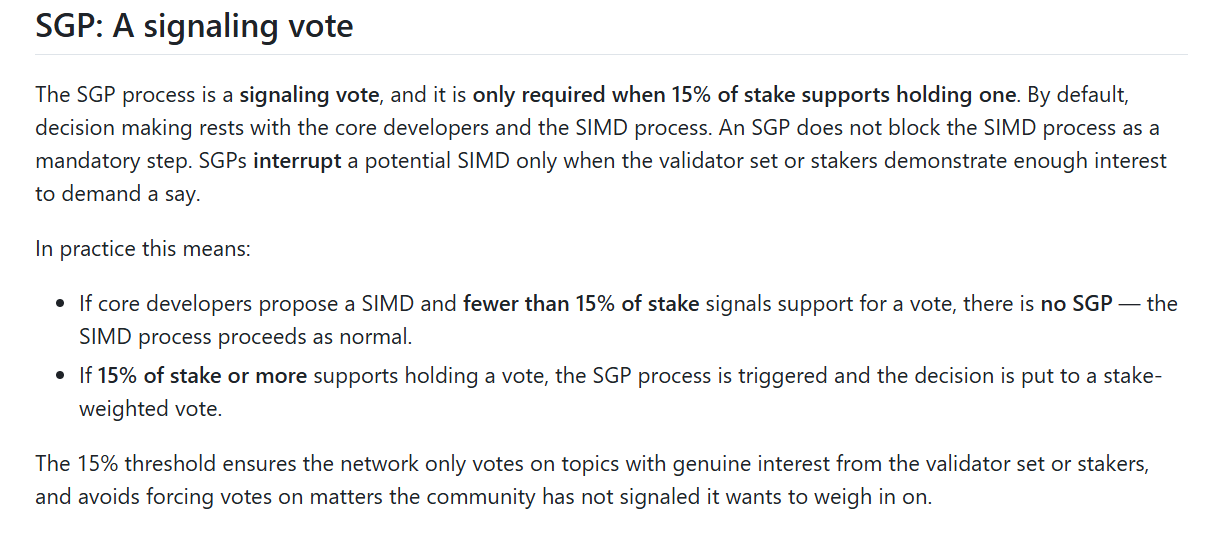
SGP voting information, minimum threshold. Source:
The Solana Foundation said that governance-level proposals will be SGPs, while smaller SIMD proposals will focus on technical protocol upgrades.
“SIMDs should focus on protocol changes, SGPs should be signals from the ecosystem,” wrote the Foundation.
Related:
In April, the Solana Foundation introduced a new security auditing framework and incident-response network for Solana-based protocols, in partnership with Web3 security firm Asymmetric Research.
The new initiative, the Solana Trust, Resilience and Infrastructure for DeFi Enterprises (STRIDE), is a “structured program for evaluating, monitoring and escalating security across Solana projects,” according to the April announcement.
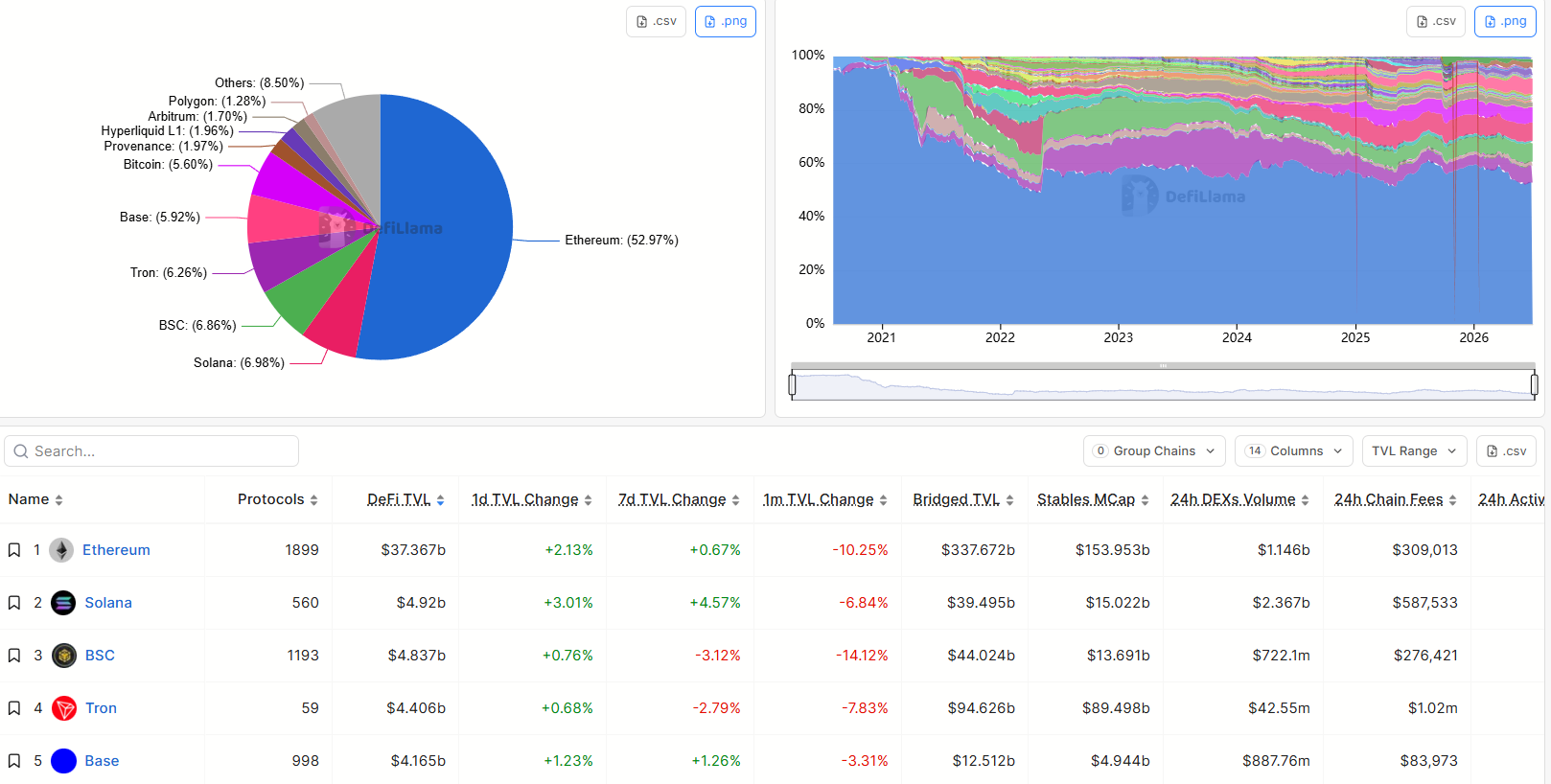
Top blockchain networks by TVL. Source: DefiLlama
Solana ranks as the second-largest blockchain network with $4.92 billion in total value locked (TVL), behind Ethereum's $37.3 billion. Solana generated over $587,000 in blockchain fees during the past 24 hours.
Magazine:
Disclaimer: The content of this article solely reflects the author's opinion and does not represent the platform in any capacity. This article is not intended to serve as a reference for making investment decisions.
You may also like
U.S. non-farm payrolls surge by 165,000 in October, far exceeding expectations! Unemployment rate unexpectedly drops to 4.1%, December rate hike expectations intensify
In October, US non-farm payrolls increased by 165,000, which is 2.5 times the Wall Street median forecast of 65,000 and represents an exceptionally strong deviation of about 5 standard deviations, exceeding the upper limit of all institutional forecast ranges. The unemployment rate unexpectedly fell from 4.2% to 4.1%, while the market had expected it to remain unchanged; average hourly wages also accelerated year-on-year growth to 3.1%. Meanwhile, the previous two months' non-farm payrolls were revised upwards by a total of 84,000. Following the release of the data, the yield on 2-year US Treasury bonds rose by 7 basis points, and the pricing of the probability of a Fed rate hike in December climbed to 70%.
AI Sell-off Hits Anthropic IPO, Potential Valuation Expected to Drop to $1.2–1.3 Trillion
The valuation range discussed by potential investors has been lowered from the previous high of $2 trillion to between $1.2 trillion and $1.3 trillion, and some strategists have even suggested going below $1 trillion to ensure safety. In the face of significant market volatility and financial concerns such as quarterly losses, Anthropic is facing tough decisions, including a discounted valuation, reducing the size of the offering, or postponing the listing.

Moderna Q3 revenue up 29% year-on-year, far exceeding expectations, raises full-year revenue growth guidance to 15%-25% | Earnings Report Insight
Moderna's Q3 revenue increased by 29% year-on-year to $1.31 billion, with profits significantly exceeding expectations. The company raised its 2026 revenue growth guidance to 15%-25%. The ramp-up of next-generation COVID-19 and flu vaccines, along with international market expansion, has driven performance improvement. Phase III data for the personalized cancer vaccine has also shown positive progress. The company is simultaneously advancing cost reduction and pipeline R&D, with year-end cash expectations significantly raised.
Crypto prices
More


