
Currency selection for carry trade

In the first half of the year, amid US-Iran tensions and the coming to power of Walsh, carry trade returns have remained stable. Among G10 currency pairs, going long the three highest-yielding pairs and shorting the three lowest-yielding pairs, the index compiled based on cumulative returns is shown in the chart below, and its performance is remarkable. This is due in part to the stable interest rate differentials among economies, and partly to the sustained decline in volatility since Q2.
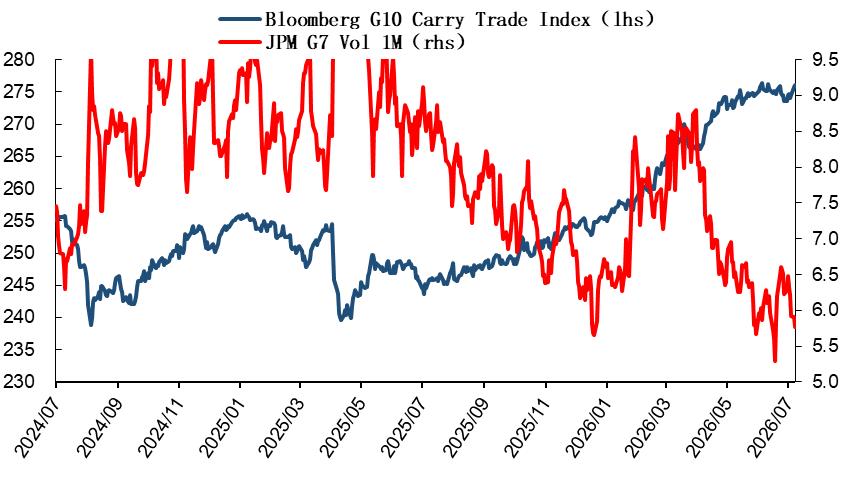
Since March, the volatility of G7 currencies has been declining, with USDCNY1Y ATM even falling to a decade low of 3.1. In such a low-volatility environment, carry trades are relatively comfortable.For traders, trades that simply earn money over time are highly attractive.
So, how do you choose the right currency pair for a carry trade?Many institutions often focus on the carry-to-vol (interest rate differential/volatility ratio) indicator. Why isn’t the interest rate differential alone enough? Because when there is a market crisis, funding currencies often see drastic swings due to crowded positions, and the accumulated carry profit can be wiped out instantly. Volatility represents the market’s pricing for uncertainty, so a low carry-to-vol means the market does not think this carry is worthwhile. Simply put, carry-to-vol expresses how much risk you need to take to earn this carry. It serves as a bridge between returns and risk in carry trades.
Current carry-to-vol ratios for major currency pairs
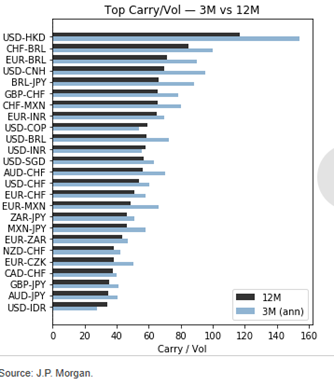
Based on the performance of indicators such as carry-to-vol, the author has selected two currency pairs from those watched daily that are suitable for carry trades:
1. USDHKD
First, the widely discussed USDHKD. Compared with other G10 currencies, it may seem a bit “boring,” but its performance this year has been very stable. Before reaching 7.85, official intervention to tighten HKD liquidity is unlikely, and at the current level of 7.84, there is still some room to go. It’s reasonable to continue holding USDHKD and earning around three points of carry per day. At the current level, it’s advisable to build positions in tranches as the Hong Kong stock dividend season is approaching, and HKD will likely face some appreciation pressure—this is a good timing to build positions ahead of dividend season.
2. GBPCHF
Secondly, among G10 currencies, the author is more optimistic about GBPCHF. According to the data, GBPCHF has a relatively high carry-to-vol; one is a high-yielding currency, the other is low-yielding, generating relatively attractive returns.The Swiss National Bank (SNB) has explicitly stated its willingness to prevent excessive appreciation of the franc, providing downside protection for GBPCHF.
Moreover, GBPCHF has some appreciation momentum among cross currencies: on one hand, the political risk in the UK has temporarily subsided, with Burnham expected to take office on July 20 and promising to adhere to fiscal discipline. On the other hand, technically, GBPCHF is forming a head and shoulders bottom after a round of devaluation. Therefore, overall, going long GBPCHF is a good choice both from the perspective of carry and trading attributes.
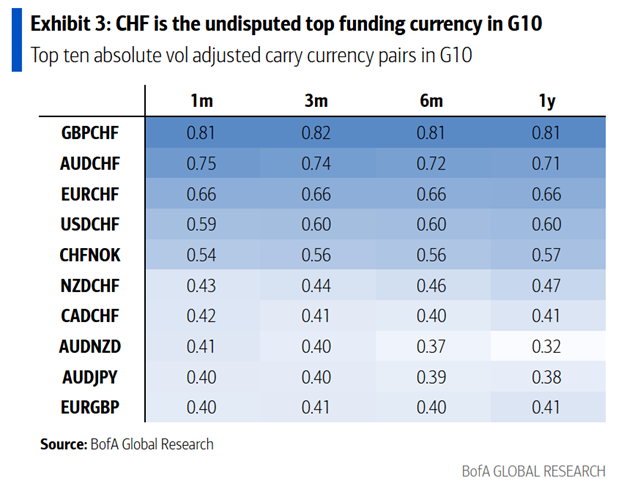
For carry trades, AUD (as the high-yielding currency) and JPY (as the low-yielding currency) also performed well in Q1 and still offer attractive interest differentials now. Why are they not being recommended? Again, the answer lies in the carry-to-vol indicator. Currently, the implied volatility for both AUD and JPY is high. In particular, the yen is at an intervention-sensitive level and is unsuitable as a funding currency; meanwhile, as a commodity currency, AUD tends to be vulnerable during periods of intensified risk aversion in the market.
Finally, from a strategic perspective, at the start of the second half of the year, there are concerns in the market about rising volatility. On one hand, this is due to seasonal historical patterns; on the other, volatility is already at historical lows, leaving little room for further decline. For risk management purposes, it may be prudent to include a certain amount of options in the portfolio to hedge the risk of rising volatility.
BFC Exchange Talks
With you through 2026
Welcome to leave us a message in the background
and communicate with us
Disclaimer: The content of this article solely reflects the author's opinion and does not represent the platform in any capacity. This article is not intended to serve as a reference for making investment decisions.
You may also like
The US debt ceiling crisis may come as early as February next year; Wall Street warns the government could face default risks as early as August.
Wall Street strategists have warned that, as the U.S. Treasury raises its borrowing expectations and plans to maintain record cash reserves, the U.S. government may reach the statutory debt ceiling as early as February 2027, significantly earlier than previously anticipated.

US Consumer Confidence Rises to Three-Month High in November as Inflation Expectations Fall, High Prices and AI Bubble Concerns Persist
US consumer confidence unexpectedly rebounded to a three-month high in November, mainly due to improved perceptions of personal financial conditions and economic outlook among the public.

Overnight US Stocks | The three major indexes were mixed; most chip stocks rebounded; Micron Technology (MU.US) rose over 5%
At the close, the Dow Jones fell by 237.32 points, down 0.46%, to 51,285.73 points; the S&P 500 rose by 23.13 points, up 0.31%, to 7,376.86 points; the Nasdaq gained 264.42 points, up 1.09%, to 24,579.42 points.
Bank of Japan Governor: Inflation Risks Are on the Upside; Unconventional Easing Tools May Be Used Again if Severe Shocks Occur in the Future
Bank of Japan Governor Kazuo Ueda stated that core inflation is expected to remain near the 2% target, with wage growth gradually aligning with inflation. However, rising energy prices have begun to impact consumer prices, and inflation may accelerate further early next year. He also noted that AI has created a positive demand shock, and with a labor shortage in Japan, AI replacing some jobs could benefit the Japanese economy.

Crypto prices
More


