
CoreWeave & Nebius Q3 Earnings Preview: AI Cloud Twins Under Heavy Debt Pressure
 2026/11/10 03:36
🔥 US Stock Hotspot Radar is Live! Content: 3 major themes + 6 selected stocks + 7 key events. Where are this week’s opportunities? Click the link to see all 22 trading directions in one chart →
1. Investment Highlights
CoreWeave (CRWV.US) will report Q3 2026 results on November 10, followed by Nebius (NBIS.US) on November 12. Consensus expects CoreWeave revenue of about $3.55 billion and Nebius around $908 million, both very close to estimates with limited beat potential. EBITDA margins are projected at roughly 58% and 39% respectively, while both companies are still expected to post per-share losses. Over the past month, the two stocks have fallen approximately 44% and 36%, nearly halving, as the market’s focus has shifted from demand strength to the sustainability of high-leverage financing. This earnings release and the accompanying conference calls will be key tests of whether funding is secured, margins can hold, and customer diversification is progressing.
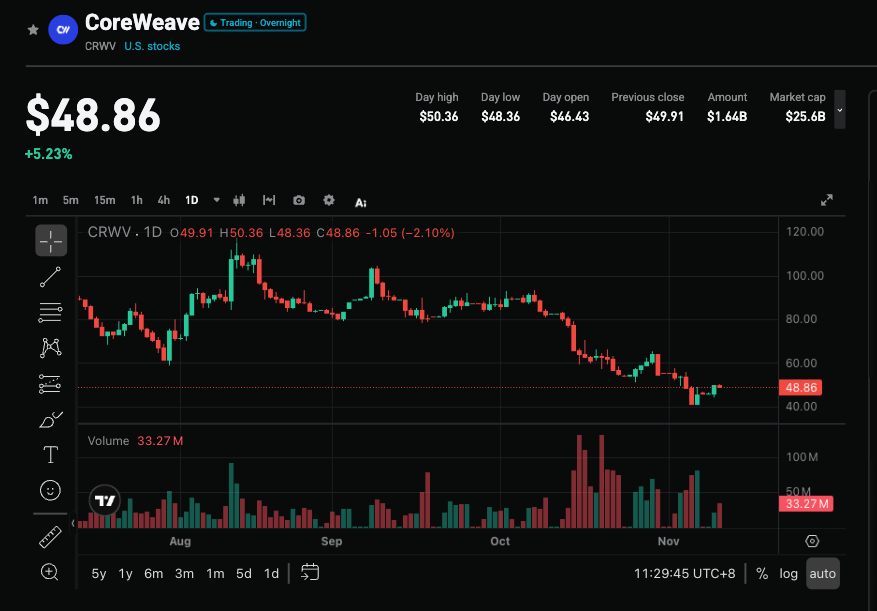
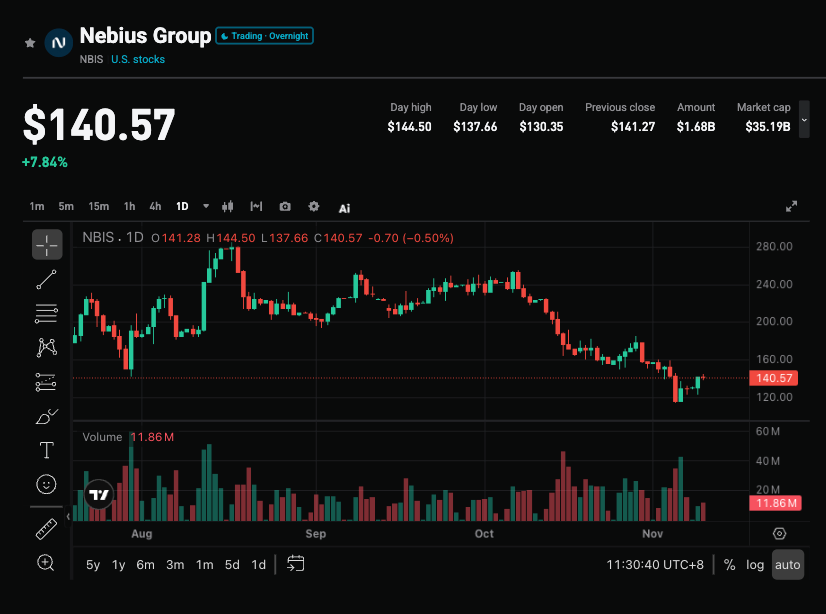
Focus 1: Can strong revenue growth offset financing concerns?
Both companies maintain robust growth trajectories. CoreWeave’s 2026 revenue is expected at about $12.86 billion, rising to $26.47 billion in 2027 (roughly +106%). Nebius is projected at $3.37 billion this year, potentially reaching $11.98 billion in 2027 (about +255%). These forecasts are supported by CoreWeave’s backlog of more than $129 billion and Nebius’s long-term contracts exceeding $40 billion. However, analyst estimates have largely caught up with the growth pace, and the expected Q3 beat is extremely narrow (only about 0.06% for CoreWeave and 0.96% for Nebius), so the headline numbers alone are unlikely to be the main catalyst.
Focus 2: Sustainability of debt and capital expenditure
CoreWeave carries roughly $50 billion in debt. In mid-October, the yield on its 2031 bonds approached 16%, and CDS spreads widened to about 1,200 basis points. In August the company raised its capex guidance to $35–39 billion, approximately three times its expected 2026 revenue. Nebius has a smaller debt load and recently closed a $3.5 billion senior secured financing facility (364-day tenor at SOFR + 275–350 bps). It is seeking asset-backed financing supported by contracted orders. The central question has shifted from “Do customers need compute?” to “Are lenders still willing to fund it?”
Focus 3: Margin resilience and free-cash-flow path
CoreWeave’s ~58% EBITDA margin is the core pillar of its debt-service case, while Nebius’s ~39% margin is rising quickly from a low base. Any deterioration in either margin could reinforce the view that GPU-rental economics are less attractive than top-line growth suggests. Investors are particularly looking for CoreWeave to outline a credible free-cash-flow positive path through 2030, and for Nebius to detail its refinancing plans for the short-term facility.
Focus 4: Customer concentration and business diversification
CoreWeave’s major customers include Microsoft, OpenAI, and Meta, creating concentration risk. Its CEO has sold nearly $1 billion of stock since the IPO through a pre-arranged trading plan, which could raise governance questions in the current environment. On the positive side, Palantir has named Nebius a preferred partner for sovereign AI infrastructure, and Nebius completed the acquisition of Inferize to strengthen its inference business. CoreWeave is expanding in Denmark and plans to build a global AI network backbone starting in Q4 covering the UAE, India, Indonesia, Singapore, Australia, South Korea, and Japan. Whether new orders extend beyond the existing hyperscalers and AI labs will be a key watch item.
3. Risks and Opportunities
Upside catalysts:
- Management clearly articulates funding sources for capex and provides a credible free-cash-flow positive timeline (especially through 2030).
- Margins hold steady or beat expectations, and customer base shows clear diversification.
- Bond yields and CDS spreads tighten after the report, confirming credit-market relief.
Downside risks:
- The conference call is dominated by refinancing questions and vague answers, leading the market to interpret funding as constrained.
- Margins decline, or signals emerge of involuntary capex reduction.
- Customer concentration remains unaddressed, compounded by CEO selling or renewed questions around the former parent Yandex.
4. Trading Strategy Considerations
Bull case: If the companies demonstrate that funding is in place, margins remain stable, and new orders show diversification, the market may conclude that the 40%+ declines have over-discounted pessimism, opening room for valuation recovery. Average analyst price targets imply roughly 183% upside for CoreWeave ($131.41) and 121% for Nebius ($286.53), with EV/EBITDA multiples already sharply compressed.
Bear case: If the numbers merely meet expectations and the calls fail to adequately address financing and free-cash-flow questions, further downside pressure becomes more likely. Credit-market reactions (bond yields and CDS) may prove more informative than the equity response.
Key metrics to watch:
- Q3 revenue, EBITDA margin, and per-share loss magnitude
- Capex funding sources and free-cash-flow timeline
- New order wins and customer diversification progress
- Changes in bond yields / CDS spreads
Positioning notes: Positive signals on funding and cash flow could create opportunities on pullbacks. Vague commentary or lack of credit-market improvement warrants caution on near-term volatility and chasing strength. Position sizing and stop-loss levels should be adjusted according to individual risk tolerance.
Disclaimer: The above content is for reference only and does not constitute investment advice.
Disclaimer: The content of this article solely reflects the author's opinion and does not represent the platform in any capacity. This article is not intended to serve as a reference for making investment decisions.
You may also like
Take-Two (TTWO.US) Q2 Conference Call: CEO says GTA VI pre-orders are "unprecedented" but refuses to raise guidance, expects a "historic year"
Take-Two held its earnings call after announcing its fiscal year 2027 Q2 results (ending September 30) after market close on November 9, Eastern Time.
Rocket Lab (RKLB.US) Q3 Conference Call: CEO Responds to Neutron Delay, Says Defect Fixed; Backlog Hits Record and Launch Price Raised to $70 Million
The most notable aspect of Rocket Lab (RKLB.US)'s Q3 earnings report is the delay of the inaugural launch of the new generation of medium-lift reusable rocket, Neutron. Due to the discovery of tiny voids between the layers of carbon fiber composites in the forward dome of the first-stage propellant tank, the target for the first launch has been postponed to "no earlier than 2027."
Morgan Stanley Maintains "Overweight" Rating for Unity (U.US): Q3 Results Reinforce Bull Market Logic, $25 Billion Acquisition Rumor Becomes "Call Option"
Morgan Stanley released a research report, maintaining an "Overweight" rating on real-time 3D game engine company Unity Software, with a target price of $62.
Anthropic withdraws IPO filing right after release! $69.3 billion fundraising details unexpectedly leaked, Nvidia, Microsoft, TSMC and others collectively bet $26 billion
The initial documents released by Anthropic indicated that the company planned to issue approximately 867 million shares at a price range of $70 to $80 per share. However, in a subsequent email, Anthropic clarified that there were errors in the pricing details and that the company would update the prospectus later.

Crypto prices
More


